
Re-Entry
Itineraries plan every hour of a journey and zero minutes of the return. A protocol for landing back into your own life without losing what the trip gave you.
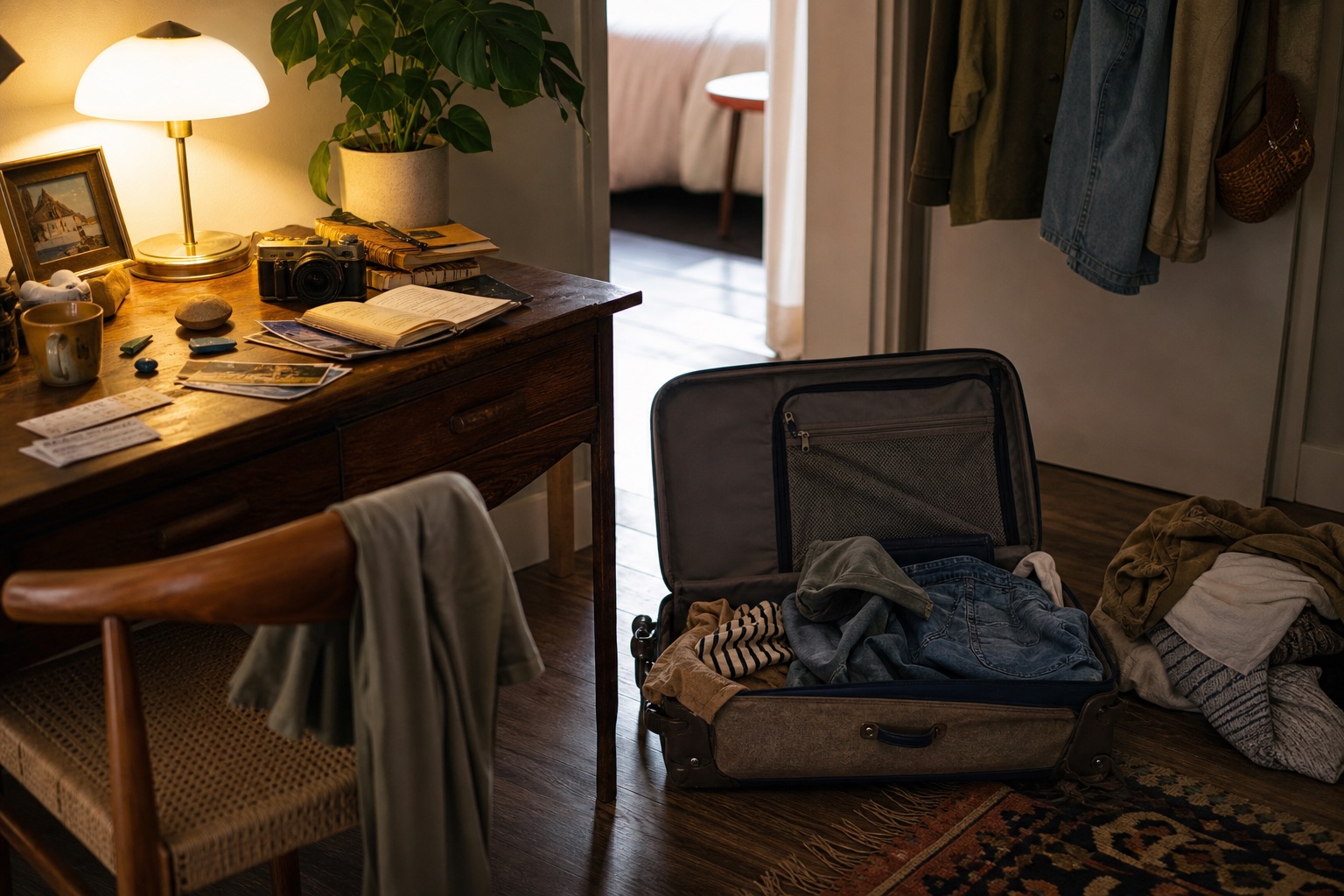
Every itinerary I have ever seen ends the same way: a flight lands, and the document stops. The trip, as planned, simply ceases at the arrivals hall — as if the traveler dematerializes at the door and reappears at their desk, refreshed and finished.
Anyone who has actually returned from a trip knows better. There is a whole final leg after the landing: the heavy-limbed homecoming, the suitcase that sits accusingly in the hallway for a week, the six hundred unsorted photos, the alarm that goes off the next morning in what feels like the wrong time zone because it is. Re-entry is a real phase of travel with real failure modes, and because nobody plans it, it fails by default. The fix costs about two hours and one calendar decision. Here is the protocol.
The buffer evening
The single most valuable re-entry decision is made weeks earlier, at booking: land with one clear evening between arrival and the resumption of real obligations. Not a full recovery day — most schedules will not give one, and the format does not require it. An evening.
The Sunday 11 p.m. landing before a Monday 8 a.m. meeting is the classic self-inflicted wound. It looks efficient at booking — maximizing the trip! — and converts the entire final day of travel into pre-dread while guaranteeing the week starts on a deficit. Pulling the return forward by even four hours changes everything downstream: the unpacking happens, the sleep happens, and Monday belongs to you instead of to your luggage.
If the calendar is yours to shape, go one step further and leave the first morning back deliberately light. Not empty — light. Re-entry does not need a vacation from the vacation; it needs a ramp instead of a wall.
The first hour home
There is a fork in the first hour after the front door closes, and the whole re-entry hinges on it. Path one: the suitcase gets dropped in the hallway "for now." Path two: it gets emptied completely, immediately, before sitting down.
Path one feels reasonable and costs a week. The unopened bag becomes furniture; the laundry inside ferments; the toiletries stay lost; and every glance at it deducts a small tax until someone finally deals with it the following weekend. Path two costs twenty minutes at the exact moment you least want to spend them — and then the trip is physically concluded.
The sequence, run as a checklist rather than a decision:
- Laundry straight to the machine — if you traveled with a dedicated laundry cube or bag, this is one motion — and start the cycle now, not tomorrow.
- Toiletries and chargers back to their standing kit, restocked as they land: the near-empty sunscreen refilled, the power bank plugged in. The next trip's packing just became trivial, and it happened while the gaps were visible.
- The suitcase itself to storage. Empty, zipped, out of sight. A stored suitcase is a completed trip; a hallway suitcase is a lingering obligation.
- The souvenirs and papers to one spot — a desk corner, a tray — to be dealt with inside the next two days, not curated tonight.
Twenty minutes. Non-negotiable. It is the entire difference between a home that absorbed a trip and a home that got hit by one.
The forty-eight-hour capture
Memory has a short half-life for exactly the details that made the trip worth taking. The name of the street with the evening market, the thing the museum guide said, which of the two cafés was the good one — this material degrades within days, and the six hundred photos will not save it, because photos capture what things looked like, not what they meant.
So the protocol's second appointment: within forty-eight hours of landing, thirty minutes with a notebook or a blank document. Not a travelogue — a capture. What was the best hour of the trip? What would I tell someone going next week? What did I overpack, underpack, book wrong, time wrong? Which place deserves a return trip and what would it be built around?
Two audiences read this document later. The first is future-you planning the next trip, for whom the logistics notes — the ratio adjustments, the transit warnings, the "skip the second museum" — are compounding capital; my last several trips were materially improved by the capture notes of the trips before them. The second audience is also future-you, years out, for whom thirty minutes of specific detail will outperform the entire photo roll at actually reconstituting what the trip felt like.
Photos get one honest pass in the same sitting: delete the failures, star the dozen keepers, done. Sorting six hundred images into albums is a task nobody sustains; rescuing the twelve that matter takes ten minutes.
The body clock, handled honestly
Crossing time zones adds a physiological layer to re-entry, and the honest version is that there is no trick — only management. The standard guidance holds: expect roughly a day of adjustment per zone crossed, anchor hard to local mealtimes from the first day home, and get morning light, which is the strongest lever available for dragging the internal clock forward. Caffeine is a tool for the morning and a saboteur after noon. The first two nights, sleep will be imperfect; scheduling the buffer evening and the light first morning is precisely what makes that imperfection survivable rather than compounding.
Eastbound returns are harder than westbound for most people — advancing a body clock is biochemically more stubborn than delaying one — so give the eastbound re-entry extra respect and, if possible, an extra margin.
Closing the loop
There is a reason to formalize all this beyond tidiness. Trips that end badly get remembered badly; the final hours color the whole. A journey that concludes with a fermenting suitcase, a sleep-deprived Monday, and an unsorted photo dump teaches its traveler, quietly, that travel is exhausting — and the next trip gets booked a little less eagerly.
Run the protocol instead — the buffer evening, the twenty-minute unpack, the capture — and the loop closes clean. The kit stands restocked for the next departure. The notes are banked. The suitcase is in the closet and the memory is in the notebook, each where it belongs. The trip ends the way it deserves to: deliberately, on the traveler's terms, with the next one already easier.
Source notes
Facts in this story were checked against the following public resources at the time of writing:
- Centers for Disease Control and Prevention, jet lag guidance
- National Institutes of Health, circadian rhythms overview
- U.S. Customs and Border Protection, declaring goods on return
- American Psychological Association, on vacation recovery effects

Samantha “Sam” Hollis
Sam is the writer and publisher of this journal. She covers the practical craft of travel — the departures, connections, and systems — from her desk in Madison, Wisconsin. More on the about page; corrections welcome via the contact page.